|
Using Timetables and Schedules
© Beverley Paine
What do you put when applying for registration as a home educator if it asks how much time will be spent on each subject or topic - minutes a day and how many days a week? Is it necessary to include a time table if it's asked for, or an outline of a daily homeschooling schedule? These are questions I'm often asked.
How long you spend on each 'lesson' depends on the age of the child/ren and the nature of the lesson.
For example, a maths lesson on exchanging (hundreds, tens, units) might take a few minutes or half an hour. I would spend as long as it took for the child to get a grasp on the concept, knowing that we would be revisiting it soon to reinforce what the child has learned. I might be using counters/matchsticks or MAB blocks (MathsUSee blokcs do the same thing) together with number cards (I made based on some I saw at a Montessori school) as well as recording on the sums on paper in a structured prepared lesson. Or I could be using anything to hand to help my son calculate a sum he wanted help with... My children would often bring sums and spelling tasks to me, asking for help and I'd use the opportunity as instant mini-lessons.
I'd often include board games as lessons. We created a shopping game that would take about an hour to play and involved a fair bit of maths. When the children were young I'd make sure they had access to the maths blocks, calculator, pen and paper so that they could do the working out themselves, even though it slowed the game down.
With maths 'book work' I'd set them as many pages as I felt the children were capable of doing before they'd get grumpy, bored or would lose interest. I remember April galloping through three levels of maths books at age 6 - she'd do six pages a day and probably more if I'd let her. By the time we got to Year 4 level the number of problems on each page had quadrupled (and doubled again the next year!) - that's when it all began to get a little bit tedious and repetitive, so we changed tack and dropped most of the bookwork, using the 'test' and 'puzzle' pages to see if she understood the concepts and could use the processes needed to calculate, etc.
Each child was different and worked at a different rate, learning and revising in different ways. For example, I had to teach maths in a very different to my youngest as he wasn't reading independently until age 11, which meant I could leave him to do bookwork on his own.
As a quick guide I'd put down lessons as lasting half an hour, but allowing for less or more as per the individual child and topic. Most homeschoolers find that the basics - reading, writing and arithmetic - can be covered in a couple of hours, usually in the morning. I would encourage my children to get up and have a drink, stretch and bite to eat in the middle of a 'study period', or when we put the maths books away and started writing.
Using a timetable generally lasts for a year or so until home education relaxes into a more natural and family family routine. Some families find timetables essential as they have a lot of 'extra-curricula' activities to squeeze into each week and it is too easy to forget to fit in art, history, and sometimes even maths lessons. As home educators we run the risk of not having enough time to fit everything we want to do into our weekly homeschooling schedules. I used a calendar and diary to help me stay on track for the first few years of our homeschooling life.
Keeping track of hours and minutes spent on each subject distracts from focusing on the much more important content of those lessons. I wouldn't want to pin it down. I'd rather make sure that I was covering a good cross-section of different areas of learning each week, with time for the 3Rs set aside each day.
Writing an outline of a typical homeschooling (stay at home) day offers a useful guide and is reassuring for the regulating authorities, but we need to remember it is a simply as snapshot of what usually happens and isn't something we need to religiously adhere to. Timetables are useful in school settings for all sorts of administrative rather than educational reasons.
This is the 'typical day' I used to offer:
* Completion of chores - personal, house hold, and animals.
* Daily focus on maths/language based activities drawn from learning program (about 1-2 hours for younger children, 2-3 hours for older).
* Snack and stretch.
* Free personal time, hobbies, including play and computer.
* Lunch.
* Time to pursue personal interests and/or on-going projects - construction, art and craft, researching, technology.
* Outside physical activity - sport, walking, swimming, tree climbing, etc.
* Music practice.
* Reading together, silent and shared.
* Chores - personal, household, and animals, preparation of family meal.
* News and current affairs, discussion and conversation.
* Watching documentaries, movies; or playing educational and fun games; or use of computer for games, projects, etc.; or quiet reading.
from http://homeschoolaustralia.com/articles/typicalday1.html

Was this article helpful? Was it worth $1.00 to you?
Your gift of $1 or more helps to keep this site operating
offering encouragement
and reassurance to families
wanting
better outcomes for their children.
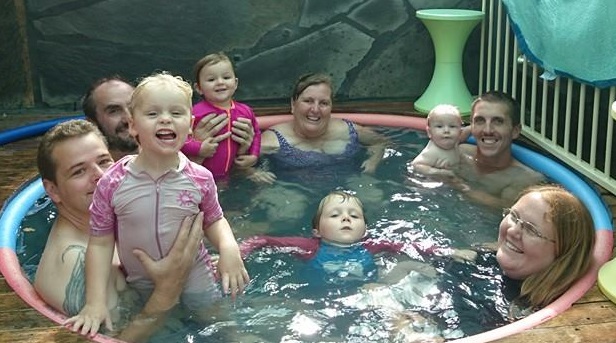
Beverley Paine with her children, and their home educated children, relaxing at home.
Together with the support of my family, my aim is to help parents educate their children in stress-free, nurturing environments. In addition to building and maintaing this website, I continue to create and manage local and national home educating networks, help to organise conferences and camps, as well as write for, edit and produce newsletters, resource directories and magazines. I am an active supporter of national, state, regional and local home education groups.
"You've been an inspiration to me, I love the way
you really listen to people." Vanessa
"Whenever I read your writing I always come away
with increased confidence in my ability to provide and
share a wonderful learning journey with my family!" Davina
"Your guidance, understanding, support and words of
wisdom changed our lives. We now offer support and
organise many homeschooling events for others." Lesley
"Thank you once again for your prompt and friendly service.
I am convinced that your books are going to add
quality and peace of mind to my journey of teaching my kids
at home! Just from studying your website, until almost
2am
in the morning, I 've been encouraged!" Louisa
"Thank you for all your many,many reassuring words
over many, many years. You probably don't know exactly how
valuable you are to the Australian Home Education community.
I've been reading your stuff for maybe 8 years or more now.
And I'm very grateful." Gythaa


Want to learn how to write your own education plans
to suit your unique children's individual learning needs?
Or you are looking for quality curriculum and teaching tips...
Comprehensive 3 workbook 'how to home ed' course
covering the essential skills you need
successfully home educate your children
|
|
Welcome to the World of Home Education
and Learning without School!
We began educating our children in 1985, when our eldest was five. In truth, we had helped them learn what they need to learn since they were born. I am a passionate advocate of allowing children to learn unhindered by unnecessary stress and competition, meeting developmental needs in ways that suit their individual learning styles and preferences. Ours was a homeschooling, unschooling and natural learning family! There are hundreds of articles on this site to help you build confidence as a home educating family. We hope that your home educating adventure is as satisfying as ours was! Beverley Paine
3 ESSENTIAL STEP BY STEP GUIDES
Let experienced home educators Beverley, Tamara and April walk you through HOW to create a learning plan that builds on solid foundations that works for YOUR family AND ticks all the boxes for home educaton registration!
|
Tap into Beverley's
experience
through her books
"Your books, your blogs helped me beyond words... they helped me to find comfort in knowing it is ok to choose exactly what is best for my family." Nisha
"Your books and information are mind blowing and already I am feeling good about this new experience." Diane
"Your guidance, understanding, support & words of wisdom changed our lives." Leslie
"I feel specially inspired by Beverley's words and, the more I read her comments, the more inspired I feel, since my need for support, respect for different parenting styles, and information are fully met." Marijo
|
 |
|


The information on this website is of a general nature only and is not intended as personal or professional advice. This site merges and incorporates 'Homeschool Australia' and 'Unschool Australia'.
The Educating Parent acknowledges the Traditional Aboriginal and Torres Strait Islander Owners, the Custodians of Australia, and pay our respects to Elders past and present and extend that respect to Aboriginal and Torres Strait Islander people viewing this website.
Advertise on this site.






Home education is a legal alternative
to school education in Australia.
State and Territory governments are responsible
for regulating home education and have different
requirements, however home educating families
are able to develop curriculum and learning programs
to suit the individual needs of their children.

Without revenue from advertising
by educational suppliers and Google Ads
we could not continue to provide information
to home educators. Please support us by letting
our advertisers know that you found them on
The Educating Parent. Thanks!
|
 About
About
 Thank you for visiting!