|
Homeschooling While Caring for Babies and Toddlers
© Beverley Paine Jun 2004
I'm often asked how homeschooling parents manage when they have little ones as well as older ones, especially in large families. Fiona asked for suggestions for encouraging older children to help with the younger ones, to make life flow better in the busy homeschool family.
It's difficult, even in a family with only three children, to make sure that no matter who I spend time with, that no one misses out on some individual attention each day. I imagine it's even harder in single parent families. I've developed a few habits to help remedy this problem, but I'm always keen to hear about how other parents cope with this perennial problem. My youngest, unlike his older siblings, slept for an hour or so in the afternoon as a baby and toddler. This allowed me to give Roger and April my undivided attention, although I was often sorely tempted to devote this time to the chores. Sometimes this meant playing with them, if they weren't in the right mood to do some concentrated educational activities, like maths or language games, or art/craft or science projects, etc. Sometimes we do some cooking - always a pleasure without Thomas clamouring for attention in one of his favourite places in the house - the kitchen!
I read to the children when nursing Thomas, cuddled up in a big bunch of cushions, or on our sofa. Some children like to be active when listening to stories - it's a good idea to organise some things they can play with safely before you settle. Perhaps a box of special toys, etc, just for reading time, close to the couch. There's nothing worse than having to interrupt the story because I'm disrupted by one child twiddling the knobs on the television...
With Thomas dozing softly across my lap reading time would often stretch for an hour or so, or the older two I would talk about all kinds of topics, sometimes related
to the stories we'd read, but mostly about dreams, feelings, toys, imaginary places... This time together is one of my most treasured memories of their childhood.
Another tip that worked well for one family was giving each child twenty or so minutes with the baby or toddler each day - in effect babysitting. It would be their responsibility to entertain (and thus educate!) and play with their little sibling, while mum attended to helping another child with learning activities. I found this naturally happened in our house. At six, April was a perfect little mother who doted on her baby brother and was only too happy, most of the time, to 'take over', and Roger often found Thomas's antics interesting and would happily become involved in
his 'games'. I think giving the older two individual attention as often as I could helped to foster the development of this affection for each other.
I rarely asked the children to share their personal belongings and taught them to respect each other's toys, pencils, books, etc, and to ask permission before they used them. This, together with the above tactic, seemed to eliminated much of the sibling rivalry I experienced as a child, and see happening with other children. I made sure there was always plenty to go around, even when other children came
to play. This was something I learned from April's time at the local Playgroup, and then at Kindergarten, where I usually stayed and helped, enjoying the company of the children, other mums and dads, and staff.
Some parents get up early to do the chores, and others like to do them late at night, when they can't be interrupted. I made the decision early in parenting life to make life as simple as possible - partly because of chronic illness. I only did those chores that were absolutely essential to maintaining a safe home - my house no longer operated on a 'keeping up appearances' basis! Over time this became easier to live with, although we had some basic rules that I insisted the children operate under; for example, there must always be a clear passage through all rooms at the end of the day - toys needed to be kept tidy and out of the way, if left out to play with again tomorrow.
II abandoned regular dusting and ironing, we did away with carpets and often shared the sweeping (the children always seemed willing to sweep small areas and I contented myself with their inexpert efforts, which gradually improved). Cooking and doing the dishes became a once-a-day communal effort, and I'd pull
Thomas's highchair close to the sink so that he could have a go to! It didn't always work so smoothly, of course.
At night I'd plan the next day's activities, organising and setting out as much as possible before I went to bed. We did bookwork at the table, Thomas on my lap, Roger next to me, and the more independent April across from me. I'm lucky - I can read upside-down writing, and could usually help her without needing to move. Roger was four when we began homeschooling, Thomas a few weeks old, and April six. Roger needed everything read to him and also required help with writing, and was one of those children who asked incessant questions!
I build a lot of educational activities into playtime - often in role playing games such as shops, 'mummies daddies', fantasy games, etc. This meant organising play props ahead of time, but I soon found that making play props, such as fake money, or hair dressing salon props, incorporated so much maths, science and language learning that it was a waste not involving the children! They learned so much through their play that eventually we gave more and more time over to playing, and less to learning from, and with, books. By asking my children to help me with many of my
chores, and by helping them with theirs, and by remembering only to tackle small amounts at a time, the children developed excellent work ethics. Working together, often with little Thomas in tow, with one or the other of us amusing or distracting him, built strong relationships between us all. The kids are now young adults and are close friends with each other - and their parents.
I demanded commitment and responsibility from my children and did my best to demonstrate these values.
I'm sure there are many more ways to organise homeschooling life around toddlers - please share your tips, advice and ideas with us all!

Was this article helpful? Was it worth $1.00 to you?
Your gift of $1 or more helps to keep this site operating
offering encouragement
and reassurance to families
wanting
better outcomes for their children.
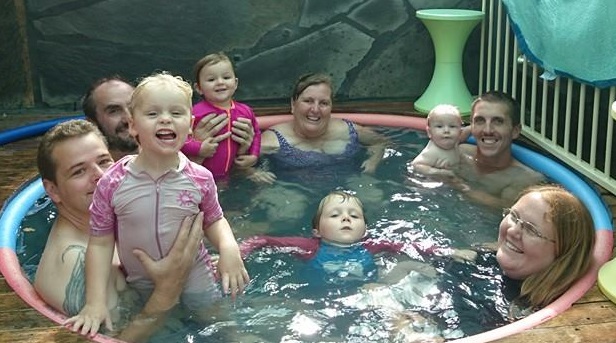
Beverley Paine with her children, and their home educated children, relaxing at home.
Together with the support of my family, my aim is to help parents educate their children in stress-free, nurturing environments. In addition to building and maintaing this website, I continue to create and manage local and national home educating networks, help to organise conferences and camps, as well as write for, edit and produce newsletters, resource directories and magazines. I am an active supporter of national, state, regional and local home education groups.
"You've been an inspiration to me, I love the way
you really listen to people." Vanessa
"Whenever I read your writing I always come away
with increased confidence in my ability to provide and
share a wonderful learning journey with my family!" Davina
"Your guidance, understanding, support and words of
wisdom changed our lives. We now offer support and
organise many homeschooling events for others." Lesley
"Thank you once again for your prompt and friendly service.
I am convinced that your books are going to add
quality and peace of mind to my journey of teaching my kids
at home! Just from studying your website, until almost
2am
in the morning, I 've been encouraged!" Louisa
"Thank you for all your many,many reassuring words
over many, many years. You probably don't know exactly how
valuable you are to the Australian Home Education community.
I've been reading your stuff for maybe 8 years or more now.
And I'm very grateful." Gythaa

CLICK HERE
if you want to learn
how to write your own education plans
to suit
your unique children's
individual learning needs?
Or you are looking for quality curriculum and teaching tips...
|
|
Welcome to the World of Home Education
and Learning without School!
We began educating our children in 1985, when our eldest was five. In truth, we had helped them learn what they need to learn since they were born. I am a passionate advocate of allowing children to learn unhindered by unnecessary stress and competition, meeting developmental needs in ways that suit their individual learning styles and preferences. Ours was a homeschooling, unschooling and natural learning family! There are hundreds of articles on this site to help you build confidence as a home educating family. We hope that your home educating adventure is as satisfying as ours was! Beverley Paine
3 ESSENTIAL STEP BY STEP GUIDES
Let experienced home educators Beverley, Tamara and April walk you through HOW to create a learning plan that builds on solid foundations that works for YOUR family AND ticks all the boxes for home educaton registration!
|
Tap into Beverley's
experience
through her books
"Your books, your blogs helped me beyond words... they helped me to find comfort in knowing it is ok to choose exactly what is best for my family." Nisha
"Your books and information are mind blowing and already I am feeling good about this new experience." Diane
"Your guidance, understanding, support & words of wisdom changed our lives." Leslie
"I feel specially inspired by Beverley's words and, the more I read her comments, the more inspired I feel, since my need for support, respect for different parenting styles, and information are fully met." Marijo
|
 |
|

The information on this website is of a general nature only and is not intended as personal or professional advice. This site merges and incorporates 'Homeschool Australia' and 'Unschool Australia'.
The Educating Parent acknowledges the Traditional Aboriginal and Torres Strait Islander Owners, the Custodians of Australia, and pay our respects to Elders past and present and extend that respect to Aboriginal and Torres Strait Islander people viewing this website.
Advertise on this site.







Australia's premier online annual conferences, lifetime access to video and audio recordings, freebies, notes and associated resource guides.
EVERY SUMMIT IS UNIQUE!
$29 each  2023 2023  2022 2021 2022 2021
$25 each 2020 2019 2017
"Biggest and best Aussie homeschool event of the year!"
Home education is a legal alternative
to school education in Australia.
State and Territory governments are responsible
for regulating home education and have different
requirements, however home educating families
are able to develop curriculum and learning programs
to suit the individual needs of their children.

Without revenue from advertising
by educational suppliers and Google Ads
we could not continue to provide information
to home educators. Please support us by letting
our advertisers know that you found them on
The Educating Parent. Thanks!
|
 About
About

 Thank you for visiting!