|
What To Do When Children Make 'Mistakes'
© Beverley Paine, August 2000
The other day I was talking to a friend who related a problem she had with her 'perfectionist' nine-year-old son with maths and language lessons. If got something wrong he would almost start to cry, really getting upset, and he wouldn't let her show him where he had gone wrong. I remember having exactly the same problems when my children were younger.
Eventually I learned that many of the prescribed lessons in the books didn't relate to my children's individual learning styles, and that often the way I had learned, and was thus teaching my children, didn't work with them - a case of clashing learning styles again. I could have forced my children to comply with my preferred way or to the books we used, but I their distress upset me. I felt like I was no better than the teachers I frequently criticised were!
I am a slow learner and by the time I realised this April had completely turned off as far as maths was concerned, with a very low confidence in her natural mathematical ability. At the age of nine I finally stood back and let her learn maths without books. Imagine my surprise and delight when two years later she achieved 95% in maths test from a year 5 class! She had learned maths by using maths in her everyday life. The problem was that I was not respecting her learning style, not observing how she learned maths, but kept trying to impose a regime I had learned and one the book extolled. It is not easy to switch from a 'teaching' regime and culture to one of 'observation first'. I am a slow learner, but I am glad my children are patient.
From time to time I supplemented natural activities with art, craft and science activities, plus a continuous emphasis on playing lots of games. Since this time I have also generally waited until my children demonstrate through daily activities an understanding of maths concepts (like division) before offering paper based maths. The best part was the complete absence of the kind of stress my friend's son experienced.
This doesn't mean to say that we never did lessons from books, or worked from maths texts. We did, frequently. They just weren't the basis of our learning program as I found the children really hated making 'mistakes' and would often avoid doing the work in order not to make them! But by removing the offending methodology and adopting something that made sense to both of us we were able to move into a phase of negotiation. We each gave ourselves permission to explore the way we individually learn, rather than blindly following a method determined by people who didn't know us at all.
Mistakes in maths seem to take on more importance than any other subject and consequently 'failing to get it right' is a much bigger deal. It is hard to relate to mathematical errors as approximations. What we really need to do is examine mistakes as the key to lock the door of misunderstanding or not understanding basic concepts contained within the problem-solving situation. At times I'd use a story telling approach to find out the workings in my child's head - why had he or she arrived at that answer. Often they didn't really know. A lot of the time my kids simply guessed the answer to the problems on the page, more often than not getting them right. Then when they got one wrong they didn't really know why. Even now my children can accurately 'guess' an answer to many mathematical problems - this opens up some curiosity in them as teenagers as to how they get right answers and often they work out the process - after the answer! They are beginning to really trust their innate mathematical abilities - in much the same way they did as very young children - without questioning.
I think this is the essence of allowing children to learn naturally. Letting them work out the process, rather than prescribing it. Being there to open up conversation and discussion about what it is they are doing, not immediately judging the result, but considering it.
I also encouraged the children to remember that they had a lifetime ahead of them to learn and that they didn't have to cram it all into twelve short years of schooling. It was important to let them have a lot of choice in what and how they learned. Most often, when working from books, if the dreadful apathy, lethargy, tiredness, or tears began to appear I'd tell the kids to put away the page they were working on and chose something else, either another page from the same book or another activity (but it had to be educational). Like me, they began to see school curriculum as completely alien to their education, preferring to use activities immediately relevant to their own lives. They continually amaze me with the amount of learning they do by not doing anything 'schoolish' at all.
Every so often I'd feel insecure with our learning naturally approach and force the children to 'hit the books'. From an early age I made it very clear the objectives of these intensive 'school at home' periods were not educational, but to shore up my lack of confidence in our preferred approach. Only after doing several hours of 'bookwork' and 'school projects' could I see that our approach achieved just as much, if not more, but in a completely different way that was impossible to direct compare. The children never complained about the imposition of school at home, even though they'd never been disciplined to complete lessons like other homeschool children we knew. I think they were happy to comply because I was very honest with my motivations and they didn't have to play 'school' very often.
One of the other ways I worked around my children getting upset when the lesson, no matter what area of learning or life is occurring, doesn't go according to plan is by asking them to try and think of different ways of doing things, encouraging lateral and creative thinking. I preferred not to use the word 'mistake', impressing on them that what many people called mistakes were actually positive learning experiences. It is all a matter of attitude. Mostly I encouraged my children to figure things out for themselves, always offering a model they could emulate. Copying is something that is held in great regard in this house - it is just another way to model learning, a great piece of learning scaffolding. I know that when my children checked for the answer before working out the sum they weren't cheating, but trying to work the sums backwards, to find the process.
My kids really respect the approach of 'have a go, don't say no' that we adopted. I don't pressure them beyond this - if they've had a go and they've said no that is good enough for me (goes for broccoli too!). If they have excellent reasons for not even having a go I respect that too - but they need to articulate them to me or whoever is involved. Being on hand to help (on their terms) was essential but I needed how to be around sensitively - being in the background was a skill that was learned very slowly. Most of education is interfering in the learning process and we parents almost feel compelled to interfere, thinking that we know best, rather than trusting the learner (not exactly how we like to be treated personally as learners though!)
It was tremendously important for me to let the children know that at all times they are responsible for the learning that occurs in their lives and that I am only around to help the process along, to facilitate access to resources and to love them.
The conversation with my friend turned around to perfection, and how a lot of children, especially homeschooled children, seem to suffer from perfectionism! I remember when my children first began writing, especially the boys. They wanted all the words to come out perfect first time! Like most kids they did the invented spelling method (which adults use when confronted with needing to spell unfamiliar words - drawing on strategies they've previously learned and also drawing on memory of related or suspected related words and contexts). The boys generally displayed unhappiness with their invented spelling. This often lead to frustration and a desire to not write, but get things written for them. I have noticed that not all children are worried their first writings don't conform and naturally seem to know the content has greater importance.
I introduced the idea of drafting, demonstrating where we adults naturally employ drafting in every day life, and letting them see my drafts, errors and all. I also let them know that often spelling isn't important, but that if someone else needed to make sense of what they had written then conforming to conventions really helped communication work. I continually stress the importance of effective communication in our lives; especially pointing to problems in the media where simple mistakes often lead to misunderstanding.
I think this took much of the pressure off to get it 'right' the first time. I also gauged when to spell for the boys and when to get them to have a go first. I also taught them how to use a dictionary. Thomas would spend a long time looking through the dictionary from an early age, especially when playing scrabble. We also looked at all the different ways we say and sound and spell words, collecting words with different meanings and same spellings, etc. I impressed on them that as they read more they would get to know more words and spelling would, for the most part, come naturally. Maturation really does play a part too. Roger proved this to me, but I had to wait until early teen years to believe it.
We did the occasional spelling test and I paid particular attention to common and recurring spelling errors, correcting them when I sensed correction would be taken as a positive step forward. Over time spelling improved, without (and I must say this really surprised me) much 'teaching' of spelling, or even regular writing.
I continuously find it easier to teach adolescents the stuff we struggle to teach younger children - in much less time too. And it sticks. But I think that has more to do with the school method of instruction (being mostly abstract stuff on paper than hands on relevant activity based learning) than anything the child brings to the learning environment.
I always tried to let my kids know that different people approach things differently and one answer for one person is different from another's - but that to get along in this crowded world we need to have common answers, common approaches, things that work for groups as well as individuals. But that difference and imagination are just as important as 'getting it right'. I believe it is important to try and keep alive that magical experimentation that is so wonderful in the first couple of years of life, trusting that we all tend to conform to the 'right answers' somewhere along the line.

Was this article helpful? Was it worth $1.00 to you?
Your gift of $1 or more helps to keep this site operating
offering encouragement
and reassurance to families
wanting
better outcomes for their children.
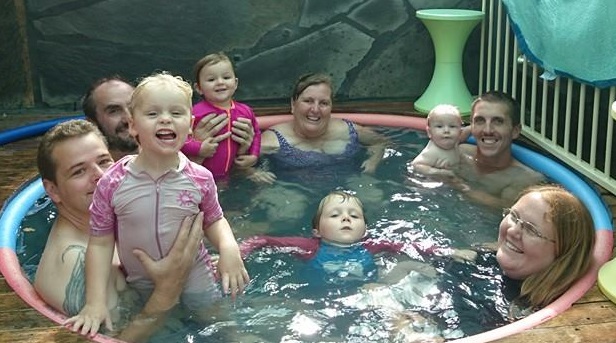
Beverley Paine with her children, and their home educated children, relaxing at home.
Together with the support of my family, my aim is to help parents educate their children in stress-free, nurturing environments. In addition to building and maintaing this website, I continue to create and manage local and national home educating networks, help to organise conferences and camps, as well as write for, edit and produce newsletters, resource directories and magazines. I am an active supporter of national, state, regional and local home education groups.
"You've been an inspiration to me, I love the way
you really listen to people." Vanessa
"Whenever I read your writing I always come away
with increased confidence in my ability to provide and
share a wonderful learning journey with my family!" Davina
"Your guidance, understanding, support and words of
wisdom changed our lives. We now offer support and
organise many homeschooling events for others." Lesley
"Thank you once again for your prompt and friendly service.
I am convinced that your books are going to add
quality and peace of mind to my journey of teaching my kids
at home! Just from studying your website, until almost
2am
in the morning, I 've been encouraged!" Louisa
"Thank you for all your many,many reassuring words
over many, many years. You probably don't know exactly how
valuable you are to the Australian Home Education community.
I've been reading your stuff for maybe 8 years or more now.
And I'm very grateful." Gythaa

CLICK HERE
if you want to learn
how to write your own education plans
to suit
your unique children's
individual learning needs?
Or you are looking for quality curriculum and teaching tips...
|
|
Welcome to the World of Home Education
and Learning without School!
We began educating our children in 1985, when our eldest was five. In truth, we had helped them learn what they need to learn since they were born. I am a passionate advocate of allowing children to learn unhindered by unnecessary stress and competition, meeting developmental needs in ways that suit their individual learning styles and preferences. Ours was a homeschooling, unschooling and natural learning family! There are hundreds of articles on this site to help you build confidence as a home educating family. We hope that your home educating adventure is as satisfying as ours was! Beverley Paine
3 ESSENTIAL STEP BY STEP GUIDES
Let experienced home educators Beverley, Tamara and April walk you through HOW to create a learning plan that builds on solid foundations that works for YOUR family AND ticks all the boxes for home educaton registration!
|
Tap into Beverley's
experience
through her books
"Your books, your blogs helped me beyond words... they helped me to find comfort in knowing it is ok to choose exactly what is best for my family." Nisha
"Your books and information are mind blowing and already I am feeling good about this new experience." Diane
"Your guidance, understanding, support & words of wisdom changed our lives." Leslie
"I feel specially inspired by Beverley's words and, the more I read her comments, the more inspired I feel, since my need for support, respect for different parenting styles, and information are fully met." Marijo
|
 |
|

The information on this website is of a general nature only and is not intended as personal or professional advice. This site merges and incorporates 'Homeschool Australia' and 'Unschool Australia'.
The Educating Parent acknowledges the Traditional Aboriginal and Torres Strait Islander Owners, the Custodians of Australia, and pay our respects to Elders past and present and extend that respect to Aboriginal and Torres Strait Islander people viewing this website.
Advertise on this site.







Australia's premier online annual conferences, lifetime access to video and audio recordings, freebies, notes and associated resource guides.
EVERY SUMMIT IS UNIQUE!
$29 each  2023 2023  2022 2021 2022 2021
$25 each 2020 2019 2017
"Biggest and best Aussie homeschool event of the year!"
Home education is a legal alternative
to school education in Australia.
State and Territory governments are responsible
for regulating home education and have different
requirements, however home educating families
are able to develop curriculum and learning programs
to suit the individual needs of their children.

Without revenue from advertising
by educational suppliers and Google Ads
we could not continue to provide information
to home educators. Please support us by letting
our advertisers know that you found them on
The Educating Parent. Thanks!
|
 About
About

 Thank you for visiting!