How We Light the Learning Fire at Home
© Rebecca Phillips
When I began considering our needs for home education, my idea's were ambitious. I pictured a house over-brimming with books, educational resources and science equipment. We would have a home library full of glossy thick encyclopaedia, a mini science lab and a room for quiet, dedicated study!
As we got further down the path, and the reality became more apparent, it was amazing to find how little really needed to change. What follows is an account of the things that I have found most important to facilitate my families' educational journey.
In the early days I knew that the main thing I wanted to "teach" my children was to be passionate about life and learning. To foster their natural innate desire to learn, I decided that I really needed to re-kindle my own desire to learn. I felt that somewhere along the way I had been trained out of that healthy curiosity that we all possessed as children..
William B. Yeats said, "Education is not the filling of a pail, but the lighting of a fire".
I wanted my own thirst for knowledge to inspire my children to be enthusiastic learners, long past their "school" years. Now I actively seek out answers, learn new skills and ponder the universe alongside my children.
With this awakened sense of curiosity in place, we needed access to information. We use the internet often, we visit the library and we have managed to collect quite a few books (though not the comprehensive home library first envisioned!). Then there's the information we gather by simply looking deeper, taking time to observe and learn from our own experiences.
And speaking of observation, here is an introduction to one of my favourite homeschooling tools. For our family I found that a simple magnifying glass was truly a special thing. Its' benefit was not in its ability to magnify, but its ability to turn our children into brave explorers of the unknown; encouraging them to look beyond the ordinary with wonder and excited anticipation.
Some homeschoolers will invest in a microscope, though I can honestly say that, so far, we have used ours little. There are other fun tools that magnify. One gadget that may entice older children to explore their world puts a highly magnified image onto the TV screen. Binoculars have been handy too, especially small ones that can be easily carried on walks. We even use ours for viewing the night sky rather than using a telescope.
Another 'tool' that I have found really fabulous has been our project table. This is, again, largely due to the atmosphere it creates rather than the object itself. Our project table is a second-hand dining table that's been cut down to about coffee table height. We found some fun foot-stools that we use as seats that can slide under the table to save space.
This table is always covered in stuff! This stuff matters - it isn't just mess to be cleared away. We respect the mess (learning) and only move it all to the middle when we eat there, which we do often. We rarely see the table bare. There are always games and puzzles and drawings and more gathered there.
Lastly I wanted to share something that has really helped me to embrace the natural learning way. When it comes to resources I have let go of my old thinking, and, developed a new, open-minded attitude. This has been a very freeing process.
For the first few years of our journey I found myself easily spending our allotted "education fund" on school type things such as workbooks the kids seemed interested in; non-fiction reference books that fitted neatly into some "schoolish" category; and games with a defined, educational type message.
Now we simply have a budget for our "education fund" and we spend it on (almost!) whatever interests us. If we feel there is a new skill to be learned we go with it. . If it's a subject to be explored (be it new or still not satiated) then we consider it. Something that will stretch and exercise our minds - great! It could be a book or a tool, a game or materials for a project - we consider it valuable to the person and their interest matters.
Of course there are issues such as not owning a money tree and everyone needing to share these funds. We remain focused though on the ideal- the respect of individual family members' interests. Allowing them, when it's possible, to explore their interests further. This may involve little or no money at all, but be about facilitating an experience - perhaps visiting a person with knowledge to impart, or visiting a place of interest.
You will find, of course, many,many things not mentioned here that are essential to your own families learning experience. What I hope though is that you will get a feel for how little you need to begin homeschooling, considering that you are each, already on the path to discovery.
Our children are already learners, as are we. All we really need to do is to continue what we have already begun. Leaning, loving and growing together as a family in our homes and in our local and global community.
Was this article helpful? Was it worth $1.00 to you?
Your gift of $1 or more helps to keep this site operating
offering encouragement
and reassurance to families
wanting
better outcomes for their children.
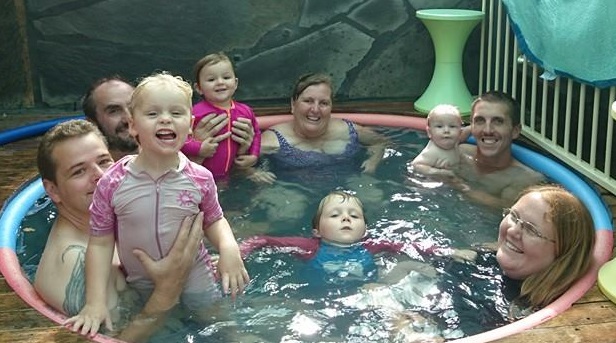
Beverley Paine with her children, and their home educated children, relaxing at home.
Together with the support of my family, my aim is to help parents educate their children in stress-free, nurturing environments. In addition to building and maintaing this website, I continue to create and manage local and national home educating networks, help to organise conferences and camps, as well as write for, edit and produce newsletters, resource directories and magazines. I am an active supporter of national, state, regional and local home education groups.
"You've been an inspiration to me, I love the way
you really listen to people." Vanessa
"Whenever I read your writing I always come away
with increased confidence in my ability to provide and
share a wonderful learning journey with my family!" Davina
"Your guidance, understanding, support and words of
wisdom changed our lives. We now offer support and
organise many homeschooling events for others." Lesley
"Thank you once again for your prompt and friendly service.
I am convinced that your books are going to add
quality and peace of mind to my journey of teaching my kids
at home! Just from studying your website, until almost
2am
in the morning, I 've been encouraged!" Louisa
"Thank you for all your many,many reassuring words
over many, many years. You probably don't know exactly how
valuable you are to the Australian Home Education community.
I've been reading your stuff for maybe 8 years or more now.
And I'm very grateful." Gythaa
 About
About










 Thank you for visiting!